
Saved✓
"Emotions and feelings which promote well-being, progress and general happiness are worth experiencing and savoring. Those which stunt our growth and stop our progression should be carefully dissected and banished from our minds and hearts."
The ABCDEs of REBT
Activating Event - Just state what happened in plain terms without blaming yourself for it.
Report the negative event.
Example: My boss wrote me up for not completing my work on time, even though I couldn't due to factors out of my control.
Belief - a belief (that is usually irrational) tied to the undesirable feelings that resulted from the event.
Identify what core belief about the event is causing you to experience an emotion that you don't want to experience.
Example: My boss should never write me up and he should know that I had extra work come up that caused me to miss my deadline
Consequence - bad or undesirable result of the belief
Identify the consequence of the belief. This can be a bit tricky sometimes.
Example: I got angry, I felt miserable, I withdrew from my family, I overate, I stayed up to late, I thought about quitting my job. ** Notice that the consequence here is not what the boss might do in the future, but specifically what you did to yourself. This is important
Dispute irrational belief - tell yourself why your belief doesn't make sense. This requires 100% honesty.
Dispute the irrational belief
Example: My boss had no way of knowing that I had external factors because I didn't tell him. I expected him to know. Also, I expect to never be written up ever and that's not rational. I feel like getting written up means I am a bad person, which it of course does not.
Effective thinking change - how can you change your thinking to avoid these bad emotions in the future?
Create an effective thinking change
Example: I need to communicate with my boss when I am overworked or overwhelmed. He is not psychic and he is also human so don't expect him to be perfect judge and don't expect him to just give you the benefit of the doubt when you are late without having told him the problem well in advance. Also, if you do get written up, so what? You are valuable no matter what!

Rinse and Repeat
Just keep doing this process every time something upsets you
You will get better and happiness will systematically return to your life. Fewer and fewer situations will cause you emotional distress because you will REPROGRAM your brain!
Dashboard
Your home base for progress

The dashboard is a customizable grid of cards. Each card tracks a different part of your Rebelief work so you can spot momentum, gaps, and next steps at a glance. Add or remove cards anytime to match what matters to you right now.
Week's Momentum
How many belief rewrites you've completed this week, with a quick list of your latest activity—your pulse check on whether the habit is sticking.
Beliefs Rewritten
Your total belief rewrites plus shortcuts to recent entries, so you can jump back into the Belief Rewriter and keep building on past work.
Mental Maps Created
How many mental map surveys you've finished, with badges for each map type—see which life areas you've explored and which are still open.
Days Logged In
Counts the unique days you've shown up on Rebelief, helping you notice consistency even when progress feels slow.
Rewriting Streak
Your current run of consecutive days with belief rewrite activity—use it to protect the habit on busy weeks.
Getting Started
Guided next steps when you're new or returning, with links to core tools so you're never stuck wondering what to do next.
Recent Notifications
A summary of counselor notes, client updates, and other alerts you shouldn't miss, with one-click access to the full feed.
Quiz Progress
Your Rebelief Quiz history and latest score as you learn the method and track how your understanding grows.
Truths Built
Effective thinking changes and personal truths you've uncovered through rewriting—reminders of insights worth keeping.
Brainstorm Pipeline
Brainstorm entries waiting to become full belief rewrites, so raw situations don't get lost before you work them through.
Urges Logged
Recent urge-tracking activity when you're working on habits or repetitive behaviors, with a count for the current month.
Mental Mapping
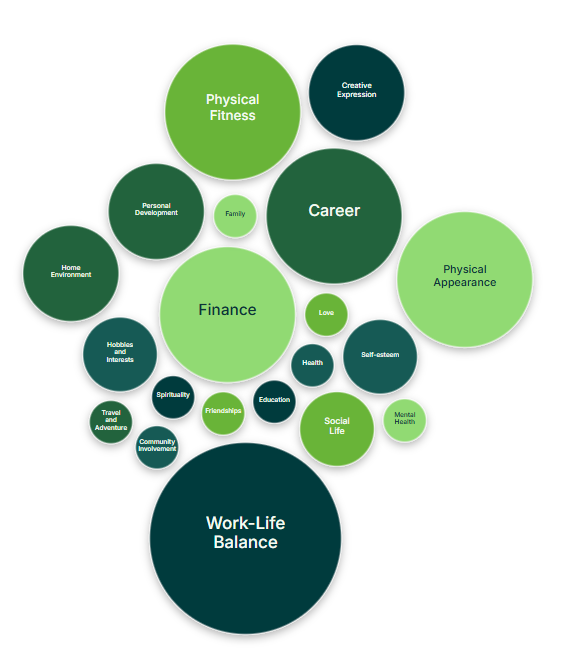
Example mental map bubble chart showing life areas such as finance, career, health, and relationships
Each survey produces a bubble view of your life areas—bigger bubbles highlight where you're placing the most weight or concern.
Rate each area of your life

Mental maps ask you to score how you're doing across the domains below. Choose a map type that fits your mood or focus—depression, anxiety, stress, relationships, goals, and more—then review where distorted thinking may be clustering.

Work-Life Balance
How satisfied you are with the boundaries between work, rest, and personal time.
Finance
Money stress, security, and whether your financial life feels manageable.
Career
How fulfilled, challenged, and on-track you feel in your work or calling.
Physical Appearance
How you feel about your body and how you present yourself to the world.
Physical Fitness
Movement, energy, and how well you're caring for your body day to day.
Home Environment
Whether your living space feels peaceful, organized, and supportive.
Personal Development
Growth, learning, and progress toward the person you want to become.
Creative Expression
Room for art, play, and making things that feel authentically yours.
Social Life
Breadth and quality of your connections outside your closest relationships.
Self-esteem
How you talk to yourself and whether you feel worthy without being perfect.
Hobbies and Interests
Joy, curiosity, and activities you do simply because you want to.
Friendships
Depth and reliability of the friends who show up for you—and you for them.
Health
Overall physical and emotional wellness beyond fitness alone.
Education
Learning, skills, and intellectual growth that matter to you right now.
Spirituality
Meaning, purpose, and whatever helps you feel connected to something larger.
Travel and Adventure
Freedom, exploration, and whether life feels expansive enough.
Community Involvement
Belonging, contribution, and ties to groups beyond your inner circle.
Family
Closeness, conflict, and how family relationships affect your daily mood.
Love
Romantic partnership, intimacy, and whether your heart feels nourished.
Mental Health
Anxiety, mood, and how steady your inner world feels right now.
Success Tracker
Celebrate every win

Small wins compound. Success Tracker makes it easy to notice progress, build confidence, and stay motivated between belief rewrites—but the deeper value is psychological: you are deliberately training your mind to see evidence that contradicts harsh self-judgment.

Why your brain dismisses success

Under stress or low mood, the mind often runs a negativity bias: setbacks feel loud and permanent, while wins are forgotten or explained away ("that doesn't count"). In cognitive therapy this is called mental filtering—one of the thinking patterns that keeps negative self-talk on repeat. Without a record, your memory skews toward failure and your inner critic gets the last word.

"The brain is like Velcro for negative experiences and Teflon for positive ones."

— Rick Hanson, neuropsychologist and author of Hardwiring Happiness

How tracking success pushes back

Each entry you log is a small piece of counter-evidence. Over weeks and months, that list becomes harder for negative self-talk to ignore. You are not arguing with your feelings in the moment—you are building a factual archive of times you showed up, coped, improved, or did something that mattered. That archive supports healthier beliefs the same way belief rewrites do: with repeated, concrete practice.

Positive psychology research on savoring and the progress principle shows that noticing meaningful forward steps—even tiny ones—lifts mood, motivation, and resilience more reliably than waiting for a big breakthrough. Success Tracker turns that research into a daily habit.

"Of all the things that can boost emotions, motivation, and perceptions during a workday, the single most important is making progress in meaningful work."

— Teresa Amabile, psychologist, Harvard Business School

"Positive emotions broaden our thought-action repertoires, widening the array of the thoughts and actions that come to mind."

— Barbara Fredrickson, psychologist, broaden-and-build theory of positive emotions

Negative self-talk loses ground over time

Harsh beliefs like "I'm a failure" or "Nothing I do matters" thrive on selective memory. When you regularly log successes, you starve those beliefs of their main fuel: one-sided evidence. In REBT terms, you are supplying real-world data for disputation—proof that the story in your head is incomplete, not gospel.

"You largely constructed your depression. It wasn't given to you. Therefore, you can deconstruct it."

— Albert Ellis, founder of Rational Emotive Behavior Therapy (REBT)

"While you can't change your experiences, you can change how you respond to them—and that can change everything."

— Martin Seligman, psychologist and founder of positive psychology

The shift is gradual. One logged win does not silence a lifetime of self-criticism. But dozens of wins, re-read on hard days, make it easier to answer the inner voice with something truer: I have evidence that I am capable, growing, and worth acknowledging. That is how success tracking works with belief rewriting—not as a trophy case, but as training for a fairer mind.

  • Log successes in seconds when something goes well—before your brain files it under "doesn't count"
  • Review your history to counter mental filtering on low days
  • Build momentum when change feels slow; progress motivates more progress
  • Share highlights with your counselor to reinforce gains in session
My Counselor
Use Rebelief alone—or multiply the impact with a counselor

The home page puts it simply: dispute beliefs that keep you stuck, track rewrites over time, and use it alone or with a counselor. Rebelief is built for honest self-work in real time. Adding a counselor does not replace that—it gives another trained mind access to the same material so sessions start deeper and stay focused on what actually hurts.

Rebelief improves counseling

Counseling works best when you and your therapist are working from the same facts. Rebelief captures beliefs, mental maps, brainstorms, and progress as they happen—so you are not reconstructing a difficult week from memory in a fifty-minute session. The comparisons below come straight from how we describe the product on the home page.

On Rebelief

Work through issues as they happen, in real time.

With your counselor

Meet with your counselor and share these issues.

On Rebelief

Focus on specific situations that are causing you pain.

With your counselor

Your counselor has more information and can help you work through your issues more effectively.

On Rebelief

100% honesty because you are the only one who sees your entries—until you choose to share.

With your counselor

Your counselor can read your entries if you choose and get right to the issue without discovering it through small talk.

On Rebelief

Very effective in rewriting your perceptions and beliefs.

With your counselor

Your counselor can check your new beliefs and help you discover even more effective ones.

On Rebelief

Snowball effect—more resolution leads to more motivation to resolve more issues.

With your counselor

Meetings become even more effective as you get better at spotting limiting beliefs and your counselor helps you work through them.

On Rebelief

Truths and solutions that come from you, so you are more likely to change.

With your counselor

Your counselor brings skill and perspective; your personal insights multiply the effectiveness.

On Rebelief

Can apply to any issue—the source and the solution both live in how you think.

With your counselor

Context you log throughout the week boosts each session—they do not need to be an expert in every detail of your life because you provide it.

On Rebelief

Entry and progress tracking—everything is stored permanently. No one's memory is perfect.

With your counselor

Your counselor can search your history in real time for previous entries and issues instead of relying on recall alone.

Why counselors matter in psychology

Self-help tools are powerful, but humans heal in relationship. A counselor offers nonjudgmental presence, trained pattern recognition, and accountability—especially when shame or distorted thinking makes it hard to see your own blind spots. Research consistently shows that the therapeutic relationship is one of the strongest predictors of good outcomes, not just the technique used.

"It's the relationship that heals."

— Irving Yalom, psychiatrist and author of The Gift of Therapy

"When someone really hears you without passing judgment on you, without trying to take responsibility for you, without trying to mold you, it feels damn good."

— Carl Rogers, psychologist and founder of person-centered therapy

"Being able to feel safe with other people is probably the single most important aspect of mental health; meaningful connections with others are at the core of what makes us human."

— Bessel van der Kolk, psychiatrist and trauma researcher, The Body Keeps the Score

"Recovery can take place only within the context of relationships; it cannot occur in isolation."

— Judith Herman, psychiatrist and trauma expert, Trauma and Recovery

"Man is disturbed not by things, but by the views he takes of them."

— Albert Ellis, founder of Rational Emotive Behavior Therapy (REBT), echoing Epictetus—why guided disputation with a counselor accelerates change

What you can do on My Counselor

My Counselor is where the connection lives inside Rebelief—invite, message, and review shared work without losing privacy over what you have not chosen to share.

  • Accept an invite from your counselor or search for local mental health providers near you
  • Send secure messages between sessions when something urgent comes up
  • Review shared session notes and interaction history in one timeline
  • Let your counselor see beliefs, mental maps, and other entries you choose to share—on your terms